How to Repurpose One Piece of Content Into a Week’s Worth of Posts
There’s a common belief among entrepreneurs that being consistent with content means constantly creating something new. Every day, a fresh idea. Every week, a completely original batch. And if you can’t keep up with that pace, you must be doing something wrong.
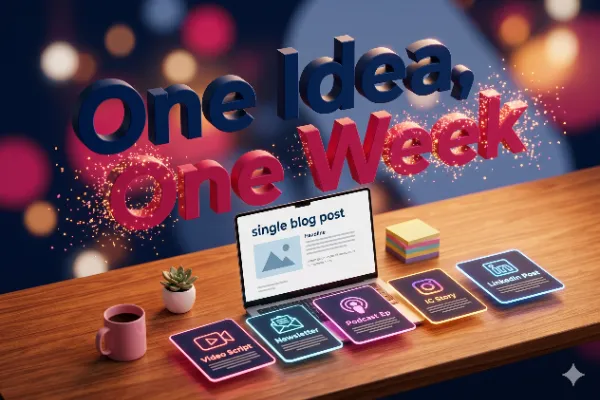
The truth is that the most consistent content creators are rarely creating from scratch. They’re taking one strong piece of content and pulling it apart into multiple formats, angles, and platforms. One idea becomes five or six pieces of content, and none of them feel repetitive because each one serves a different purpose.
If you’ve ever felt like you can’t keep up with the content treadmill, this approach is going to change how you think about your workload.

Start With One Anchor Piece
The process starts with what I call your anchor piece. This is one substantial piece of content that goes deep on a single topic. A blog post, a long-form LinkedIn post, a podcast episode, a video, or even a detailed email. The format doesn’t matter as much as the depth. It needs to be rich enough that you can pull multiple ideas out of it.
For example, a single blog post about how to simplify your tech stack might contain five or six distinct ideas: a personal story about your own experience, a practical tip about consolidating tools, a myth you’re busting, a client example, a statistic, and a call to action. Each one of those can become its own standalone post on another platform.
Breaking It Down Into Smaller Pieces
Once you have your anchor piece, you work through it looking for individual moments that could stand on their own. Here’s how that typically breaks down.
Pull out a personal story. If your anchor piece includes a moment from your own experience or a client story, that becomes an Instagram or Facebook post. Personal stories are some of the highest-engaging content on social media because they feel human and relatable.
Extract a practical tip. Most long-form content contains at least one actionable takeaway. Turn that into a Threads post, a LinkedIn tip, or a short-form reel. Keep it focused on one specific thing the reader can do today.
Reframe as a question. Take one of the ideas from your anchor piece and pose it as a question for your audience. This works especially well on Threads and in email subject lines because it invites people into a conversation.
Create a quote or key statement. Find the single sentence in your anchor piece that captures the core message. That becomes a graphic, a text-based post, or even the opening line of an email.
Write an email that goes deeper. Take one section of your anchor piece and expand on it in your weekly email. Add context your social posts didn’t have room for, or share a more personal take. Your email list gets the deeper version.
Suddenly, one blog post has given you a social post, a Threads post, a LinkedIn post, a graphic, and an email. All from the same source material, none of them identical, all of them on-brand.
Why This Works Better Than Starting Fresh Every Day
I talked about messaging pillars and content types in my post What to Post When You Have No Idea What to Post. Repurposing is what makes that framework sustainable in practice. Your anchor piece is built around one of your messaging pillars, and each repurposed piece uses a different content type to deliver the same core idea.
This is also what turns a to-do list into a strategy, which I explored in The Difference Between a Marketing Strategy and a To-Do List. When every piece of content connects back to the same anchor, your messaging builds momentum instead of scattering in different directions.
How Marketing Studio Makes This Even Easier
Inside the JLM Growth System, Marketing Studio already works this way. When it creates your weekly content plan, the posts are built around your messaging pillars and designed to connect to each other. It generates content for multiple platforms from the same strategic foundation, which means your social posts, emails, and blog content all reinforce the same message without you having to manually repurpose anything.
If you prefer to repurpose manually, the framework above will serve you well. But if you want the process handled for you, Marketing Studio takes the thinking out of it entirely.
One Good Idea Is All You Need for the Whole Week
You don’t need 20 ideas a week to show up consistently. You need one good idea and a system for turning it into content that works across platforms. The pressure to constantly create something new is the fastest path to burnout. Repurposing is the sustainable alternative, and your audience will never notice because each piece feels fresh in its own context.
Want a content system that repurposes for you?
Marketing Studio creates multi-platform content from your strategy automatically, all inside the JLM Growth System. → See how it works
Or if you want to talk through your content workflow, book a Quick Tech Chat and I’m happy to help.